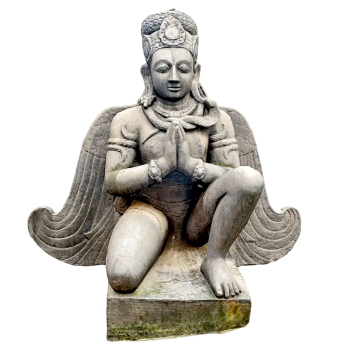
The Bamboo Root Carving Arhat, a Lucky Lion, was created by Liang Fengzhu
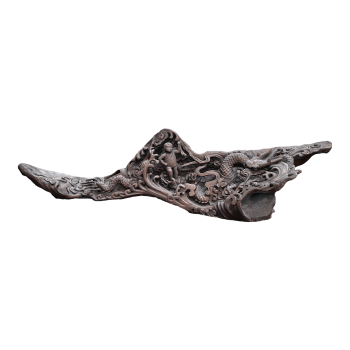
The Bamboo Root Carving Arhat, a Lucky Lion, was created by Liang Fengzhu

Ruishi Luohan Bamboo Root Carving, a 1999 work by Liang Fengzhu, a master of Chinese arts and crafts. It is currently collected in the Liangfengzhu Arts and Crafts Museum in Nanyue, Hengyang, China, with a height of 21 cm and a width of 23.2 cm
Nezha's Chaos in the Sea "created by Liang Fengzhu

Nezha's Chaos in the Sea "created by Liang Fengzhu

The gloomy wood carving, made by Chinese master of arts and crafts Liang Fengzhu in 2001, is now collected at the Liang Fengzhu Arts and Crafts Museum in Nanyue, Hengyang, China. Nezha is a protector deity in Chinese folk religion. His official Taoist name is' Marshal of the Middle Altar '. After he became a deity, he was bestowed with the title of "Third Lotus Prince".
Why was born into slavery, created by Jean Baptiste Calvo

Why was born into slavery, created by Jean Baptiste Calvo

As one of the most powerful expressions of abolitionist sentiment in visual art, "Why Born Enslaved!" depicts an African woman who is bound by ropes and provocatively looks up. The rope painfully pressed against her breasts; Her tattered shirt hinted at the violence that caused her illness. The original colored surface is covered with complex and intricate shadows and subtle shapes. There is evidence to suggest that this masterpiece of 19th-century French sculpture is the primary model for numerous castings in other museum collections. It is currently housed in the Cleveland Museum of Art.
Shang Dynasty Sanxingdui bronze ware "Shang Bronze Man Head"

Shang Dynasty Sanxingdui bronze ware "Shang Bronze Man Head"

This cultural relic is a bronze ware from the Shang Dynasty, with a human head of Fang Yi. It comes in two types: flat topped and round topped, with large or vertical ears and perforated earlobes. Garlic nose, wide mouth, and thick neck. Wrap the hair backwards and add braids or hair accessories to the back of the head. It is currently collected in the Sanxingdui Museum.
The specimen of Tyrannosaurus rex fossil at the Vienna Museum of Natural History

The specimen of Tyrannosaurus rex fossil at the Vienna Museum of Natural History

Tyrannosaurus belongs to the Tyrannosaurus genus of the Tyrannosauridae superfamily and is the only species in this genus. It was named in 1905 by American paleontologist and member of the American Academy of Arts and Sciences, Henry Osborne. If we refer to the translation format of other dinosaur species, it would be more appropriate to translate its species name as' King Tyrannosaurus'. Adult Tyrannosaurus rex is about 12 meters long and weighs around 7 tons, making it one of the largest land predators in Earth's history. This specimen fossil is currently preserved at the Vienna Museum of Natural History.
The Spanish Civil War Memorial "Eric Stanford"

The Spanish Civil War Memorial "Eric Stanford"

A fully restored Spanish Civil War memorial has been put back into use in Forbury Gardens. Reading Mayor Tony Jones presided over the event in the monastery district, with representatives from the borough council, unions, and other local groups also attending. The ceremony was held almost 25 years after the statue was first unveiled in May 1990. This monument was created by local sculptor Eric Stanford and, after four years of fundraising, depicts the mothers of those who died in Spain during the 1936-39 Civil War. At least 16 people from or associated with Reading were killed in the battle.
The specimen plate dinosaur fossil specimen at the Vienna Museum of Natural History

The specimen plate dinosaur fossil specimen at the Vienna Museum of Natural History

Banlong is an ancient dinosaur from the Triassic period, which lived between 222 million and 200 million years ago. It was the first giant dinosaur to appear on Earth. Before the appearance of the Banosaurus, the largest herbivore had a body size as big as a pig, while the Banosaurus was much larger, with a body the size of a bus. Banlong, meaning "flat reptile," is an ancient dinosaur that lived 210 million years ago during the Late Triassic period. It has a body length of 6-8 meters, a height of 3.6 meters, and a weight of about 5 tons. According to archaeological research, it was the first giant dinosaur that lived on Earth and ate plants. The specimen is currently preserved at the Vienna Museum of Natural History.
The Madonna and Child painting created by Michelangelo
The Madonna and Child painting created by Michelangelo

Michelangelo Bonaroti's painting of the Virgin Mary, created around 1547-1555. The Cathedral Opera House Museum in Florence, Italy. This painting of the Virgin Mary is Michelangelo's penultimate sculpture. In 1555, the elderly Michelangelo destroyed this sculpture after discovering a defect in the marble. In 1671, Cosimo III de 'Medici purchased the reconstructed sculpture and placed it in the basement of San Lorenzo Cathedral. In 1722, it was transferred to the Florence Cathedral.
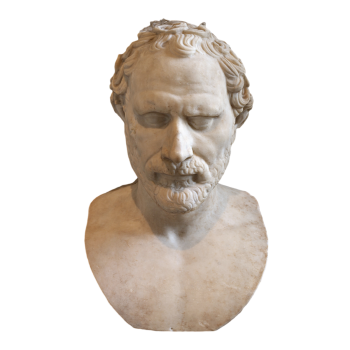
The bust of Demosthenes, a sculpture from the ancient Greek period in the 3rd century BC

The bust of Demosthenes, a sculpture from the ancient Greek period in the 3rd century BC

Demosthenes studied rhetoric from Isseus in his early years and taught rhetoric to Xuan. Subsequently, he engaged in political activities and strongly opposed Macedonia's invasion of Greece, delivering speeches such as the "Anti Philip Speech" to condemn the expansionist ambitions of Macedonian King Philip II. After the Battle of Catalonia (338 BC), he fled overseas. In 323 BC, Alexander III of Macedonia died and returned to Athens to organize an anti Macedonian movement. After failing, he committed suicide. The statue is currently housed in the Louvre Museum.
The cast iron statue of the Sphinx in front of the French Military Museum

The cast iron statue of the Sphinx in front of the French Military Museum

The Sphinx statue stands between museums and streets in Paris. Made by Ducel Foundry, which was one of the most important foundries in France at that time.
The marble statue "Ugolino and His Sons" collected in the Rodin Museum in Paris

The marble statue "Ugolino and His Sons" collected in the Rodin Museum in Paris

Ugolino and his sons are Ugolino marble sculptures made by Jean Baptiste Carpeaux in Paris in the 1860s. It depicts the story of Ugolino in Dante's Inferno, where a 13th century Count is imprisoned and starving with his children. This work is known for its expressive details, which opened up Karbo's career. It is currently housed in the Rodin Museum in Paris.
Third century Roman Empire helmet "Inlaid Golden Cavalry Helmet Nidbieber Style"

Third century Roman Empire helmet "Inlaid Golden Cavalry Helmet Nidbieber Style"

The type of cavalry helmet is the Niederbieber style, with hinged X-bars and long neck guards. Fold the edge of the neck protector (upwards) to create a clear edge impression. The helmet is currently housed in the Nijmegen Museum in the Netherlands.
The "Monchanen Vase" produced by the S è vres National Manufacturing Plant

The "Monchanen Vase" produced by the S è vres National Manufacturing Plant

The size of this vase is quite slender and simple, with a blue white background and white flowers with blue stems on top. At the base, there is a blue large leaf decoration with fine lines, while the long stem rises towards the neck and blooms with small white flowers. The simplified floral decoration, while appropriately reminiscent of soapberry flowers, emphasizes the slender lines of the vase, with the bouquet blooming on the shoulders. Currently collected at the Saints City Museum.
Bronze pterosaur from the Warring States period
Bronze pterosaur from the Warring States period

The vivid sculpture is reflected in its bronze posture, arrogant head posture, and apparent agility of the body. The strong comma shaped tails and their lively clusters, as well as the double rope pattern on the beard, are typical elements of art during the Warring States period. This statue is one of a pair, measuring 17.78 x 20.8 centimeters. This artifact is currently housed in the Minneapolis Museum of Art.
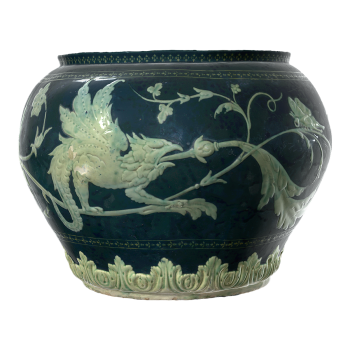
The ceramic "Fengxiang Pink Porcelain" from the Jiaqing period of the Qing Dynasty
The ceramic "Fengxiang Pink Porcelain" from the Jiaqing period of the Qing Dynasty

This Chinese cultural relic is a porcelain vase from the Jiaqing period of the Qing Dynasty (1796-1820). The vase is made of transparent and colorless underglaze powder colored porcelain, fired in Jingdezhen, and is now collected in the Patna Museum of Art and History.
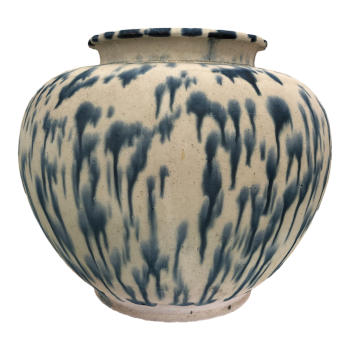
During the Kaiyuan period of the Tang Dynasty, the ceramic "Tang Dynasty Cobalt Pottery Jar"

During the Kaiyuan period of the Tang Dynasty, the ceramic "Tang Dynasty Cobalt Pottery Jar"

Tang Dynasty cobalt pottery jars are a very rare type of pottery, characterized by the use of cobalt blue glaze. In the Tang Dynasty, cobalt blue glaze was very popular, but due to the high price of high-quality cobalt ore, it was usually only used sparingly. Chinese cobalt ore contains manganese, so its color tends to be darker. The glaze of the jar flows during the firing process, so it stops before the feet, which is a characteristic of Tang Dynasty lead glazed pottery. It is currently housed in the China Ceramic Museum.
Sandstone sculpture from the Northern Wei Dynasty titled 'Stone Statue of Buddha Sitting in Four Sided Shrine'

Sandstone sculpture from the Northern Wei Dynasty titled 'Stone Statue of Buddha Sitting in Four Sided Shrine'

This Chinese cultural relic is a seated Buddha statue in a four sided shrine, made during the Northern Wei Dynasty and carved from sandstone. Unearthed in 1957 in Nanguoshui, Qin County, with severe weathering on the surface, it is collected by the Nanguoshui Stone Carving Museum in Qin County. A total of 4 niches were unearthed, each engraved with 4 Buddha statues.
The plaster statue of Avalokitesvara Bodhisattva sitting in Pakistan in the third century

The plaster statue of Avalokitesvara Bodhisattva sitting in Pakistan in the third century

This statue, known as the seated statue of Avalokitesvara Bodhisattva, was made in the 3rd to 4th century AD and originated from Pakistan. It is currently housed in the Jingci Art Museum and is made of plaster material. This sitting Avalokitesvara Bodhisattva wears a tall Tibetan style crown on his head, earrings hanging from his earlobes, his eyes slightly closed, and he meditates with a calm and relaxed facial expression, showcasing the unique charm of the plaster statue.
Jingdezhen Blue and White Porcelain Vase "from the Kangxi period of the Qing Dynasty

Jingdezhen Blue and White Porcelain Vase "from the Kangxi period of the Qing Dynasty

This Chinese cultural relic is a porcelain vase from the Kangxi period of the Qing Dynasty (1662-1722). The vase is made of transparent and colorless underglaze blue and white porcelain with cobalt pigment, fired in Jingdezhen, and is now collected in the Smithsonian Museum.
Tyrannosaurus rex skeleton fossil, American Museum of Natural History
Tyrannosaurus rex skeleton fossil, American Museum of Natural History

Tyrannosaurus belongs to the Tyrannosaurus genus of the Tyrannosauridae superfamily and is the only species in this genus. It was named in 1905 by American paleontologist and member of the American Academy of Arts and Sciences, Henry Osborne. If we refer to the translation format of other dinosaur species, it would be more appropriate to translate its species name as' King Tyrannosaurus'. Adult Tyrannosaurus rex is about 12 meters long and weighs around 7 tons, making it one of the largest land predators in Earth's history.
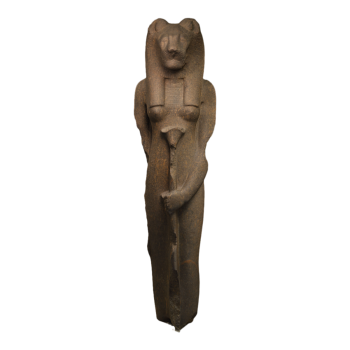
The Sykes Standing Statue, a diorite statue from the 18th Dynasty of ancient Egypt

The Sykes Standing Statue, a diorite statue from the 18th Dynasty of ancient Egypt

This cultural relic is a granite diorite statue of the 18th Dynasty standing in the position of Saikemaite. This is a statue depicting the goddess Sykes, who appears in the form of a lion headed female body but wears a sacred female wig. Her left foot is forward, her left hand holds a papyrus staff, and her right hand holds the Ankh of Life. Most of the right arm of this statue has been lost. The height of this statue is 120 centimeters, the width is 49 centimeters, and the depth is 47 centimeters. It is currently housed in the British Museum.
Maria Sobanska bust created by Konstantin Lashka

Maria Sobanska bust created by Konstantin Lashka

The name of the statue is "Maria Soba ń ska's bust", created by artist Konstanty Laszczka in 1918. This artwork is carved from Carrara marble and is a life sized sculpture. The details of this work are handled perfectly. Maria Sobanska was born into a powerful aristocratic family in Skarzky and lived from 1887 to 1948. It is currently housed in the Gorice Regional Museum.
Saiko and the Jar "created by Bertel Thorvaldsen

Saiko and the Jar "created by Bertel Thorvaldsen

The name of this cultural relic is "Saike and Jar", created by artist Bertel Thorvaldsen in 1806. This work is made of gypsum and is 1.32 meters high. It is currently housed in the Thorvaldsen Museum in Copenhagen, Denmark.
Simulated Crown Prop by Jan Matejko Academy of Fine Arts in Krakow

Simulated Crown Prop by Jan Matejko Academy of Fine Arts in Krakow

This crown is a prop from the Jan Matejko Academy of Fine Arts Museum in Krakow, Poland. The Jan Matejko Academy of Fine Arts is the oldest art academy in Poland, founded in 1818 and granted full autonomy in 1873. This college is located on Matejko Square in the center of Krakow city.